
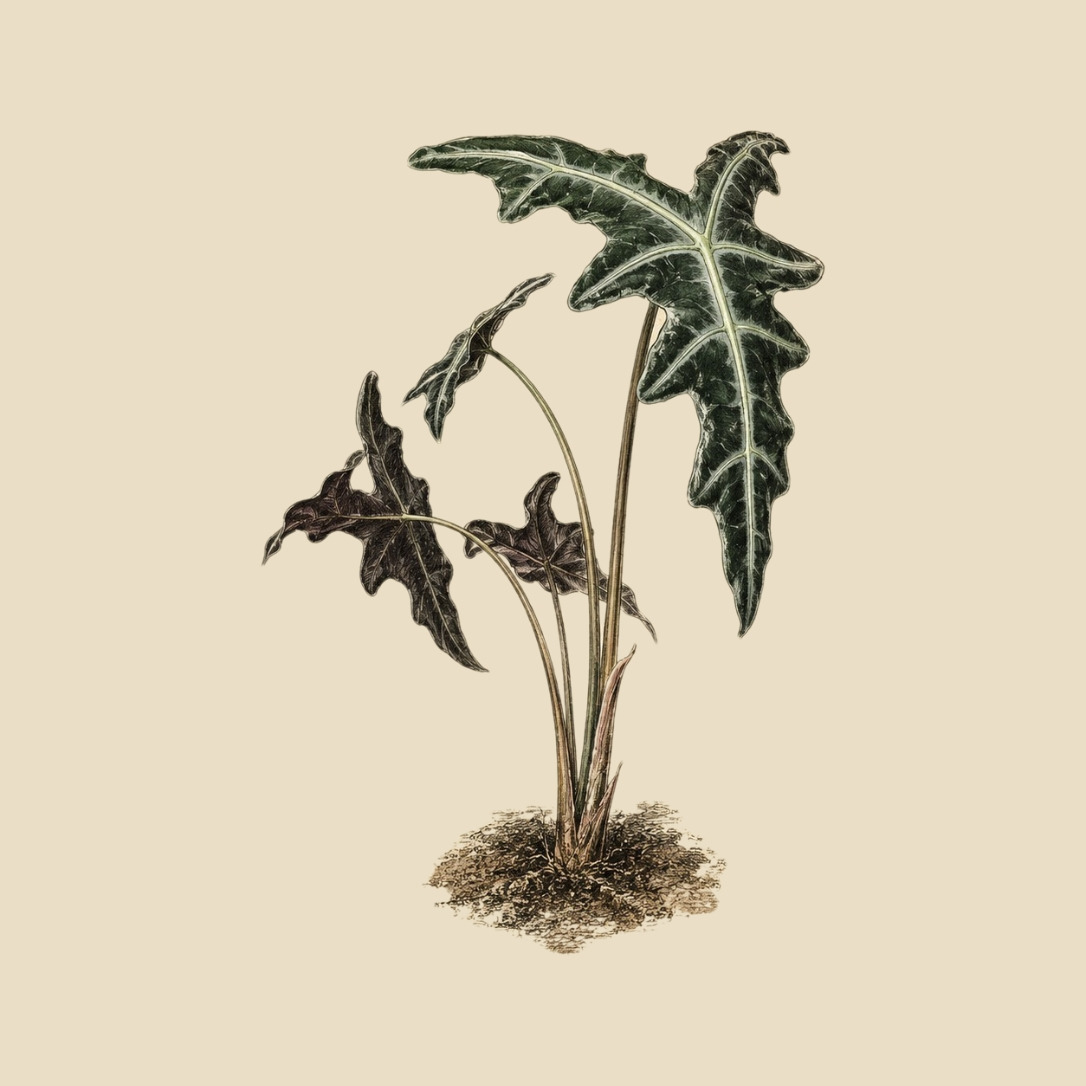
Plate 006
At a Glance
Light Bright indirect
Water Every 4 days
Humidity high
Temp. 18–28 °C
Habit Upright
Growth Medium
Care Moderate
Height 60–90 cm
Add to your collection
trade_name Araceae ◈ Community
Alocasia sanderiana 'Nobilis'
Nobilis Alocasia · Sanderiana Nobilis · Elephant Ear
(al-oh-KAY-see-uh san-der-ee-AH-nuh)
At a Glance
Light Bright indirect
Water Every 4 days
Humidity high
Temp. 18–28 °C
Habit Upright
Growth Medium
Care Moderate
Height 60–90 cm
Add to your collection
Origin & Habitat
Philippines
Botanical Notes
Alocasia sanderiana originates from the Philippines and was first documented in the 19th century. The genus name 'Alocasia' is derived from a rearrangement of the Greek word 'Colocasia.' The 'Nobilis' cultivar was developed through selective breeding to emphasize the dramatic white venation on deep green foliage, making it a showier houseplant than the species form.
Care Guide
Keep soil consistently moist but not waterlogged, and maintain high humidity with regular misting or a pebble tray. Provide bright, indirect light and protect from cold drafts and temperature fluctuations below 18°C. Feed bi-weekly during the growing season and reduce watering in winter when growth slows.
Feeding
Bi-weekly during growing season (spring–summer)
Notes & Curiosities
- The 'Nobilis' cultivar features striking deep green leaves with prominent silvery-white veining that intensifies with proper lighting conditions.
- Alocasia sanderiana is named after Henry Frederick Conrad Sander, a renowned 19th-century orchid collector and horticulturist.
- This plant thrives in humid, tropical environments and is sensitive to dry air, making it ideal for terrariums or bathrooms with bright windows.
⚠ Toxicity: toxic to pets, toxic to humans. All parts contain calcium oxalate crystals; ingestion causes mouth and throat irritation, difficulty swallowing, and gastrointestinal upset in pets and humans
◈ Community Flag an error